
Journal
How to Measure Mahjong Tiles for Rack Fit

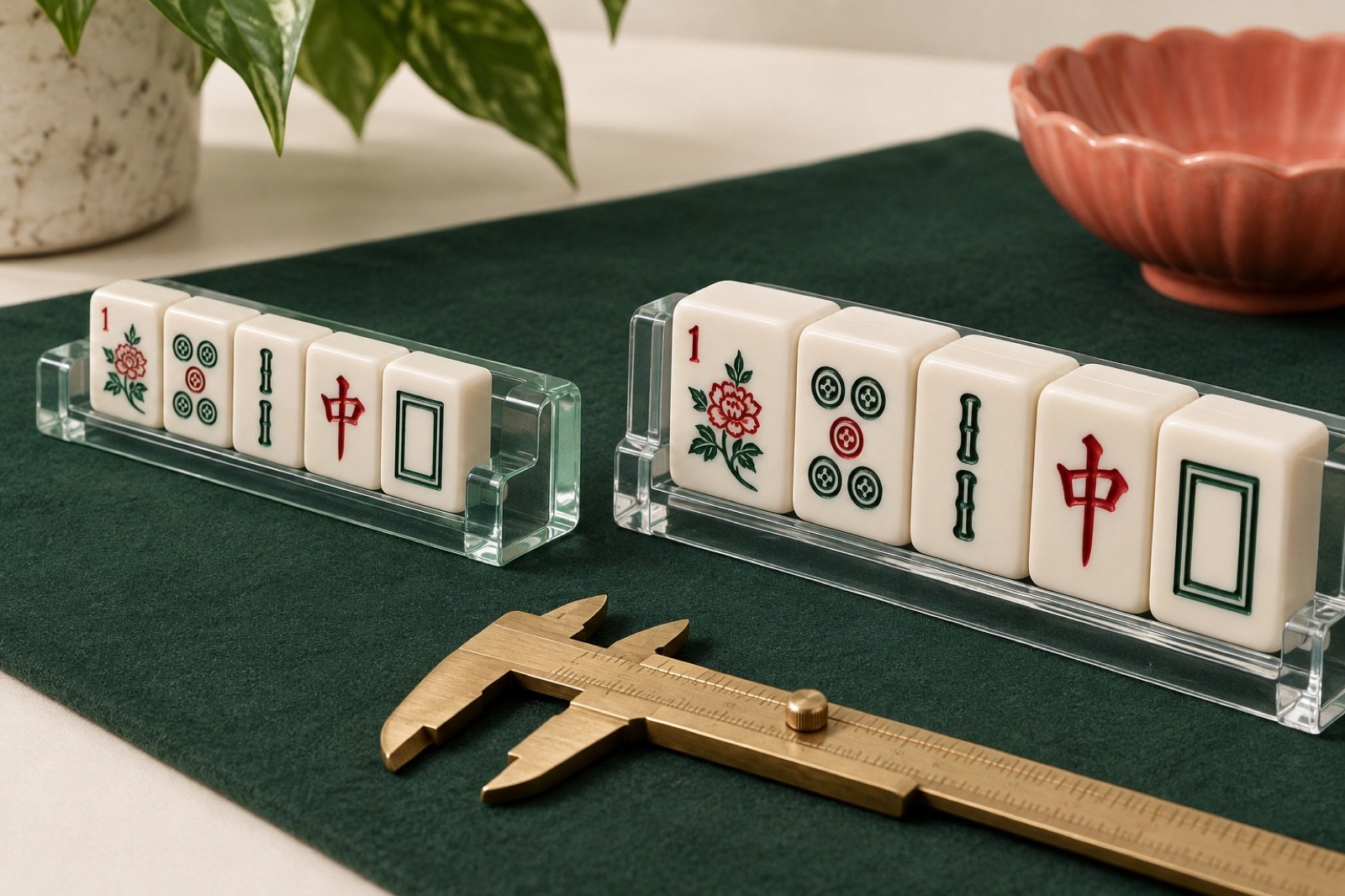
Rack compatibility is a geometry problem. A tile must sit deeply enough to feel stable, remain visible above the channel, and leave enough rack length for a complete hand without pinching neighboring tiles.
Measure tile thickness, height and width; then measure rack channel width, depth, angle and usable length. Test several tiles together because small manufacturing differences become more obvious across a full hand.
Measure the tile accurately
Use a ruler with millimeter marks or a simple caliper. Measure height from bottom edge to top edge, width across the face, and thickness from front to back. Repeat on several tiles from different suits because molded pieces can vary slightly.
Do not include a raised symbol or decorative bump when measuring structural thickness unless it contacts the rack.
- Tile height
- Tile width
- Tile thickness
- Variation across five to ten tiles
Measure the rack channel
Measure the opening where the tile rests, the depth of the lip, and the usable horizontal length. Note whether the channel is vertical or tilted toward the player. A deep channel may hide too much of a mini tile, while a shallow narrow channel may not support a thick tile.
Integrated pushers can reduce usable length at one or both ends, so measure the actual tile area rather than the rack's outer length.
Run a full-hand test
One tile standing securely does not prove that a rack works. Place enough tiles to represent a normal hand and add a little spacing for sorting. Check whether the last tile crowds the end cap and whether tiles can be lifted without disturbing their neighbors.
Tilt the rack slightly as it might move during play. The row should remain stable without wedging tightly.
Watch for three common mismatch signs
Leaning means the channel does not support the tile at the intended angle. Pinching means the channel is too narrow or the lip presses the face. Crowding means the rack lacks usable length for the tile width.
A temporary felt strip can sometimes reduce a loose fit, but it should not hide a fundamental mismatch or leave adhesive on the rack.
Buy components in the right order
When building a mixed set, choose tiles first, racks second, mat third, and bag last. Tiles establish the critical dimensions; the bag must then accommodate the longest and heaviest finished component.
Frequently asked questions
Can any Mahjong tiles fit any rack?
No. Tile thickness, height and width vary, as do rack channel depth, opening, angle and usable length.
How many tiles should I test on a rack?
Test a full-hand row rather than one tile so you can evaluate crowding, spacing and end clearance.
What causes Mahjong tiles to lean in a rack?
The channel may be too wide, too shallow, or angled differently from the tile's proportions.
Reviewed for clarity and accuracy in September 2026.