
Journal
How to Organize Your American Mahjong Rack

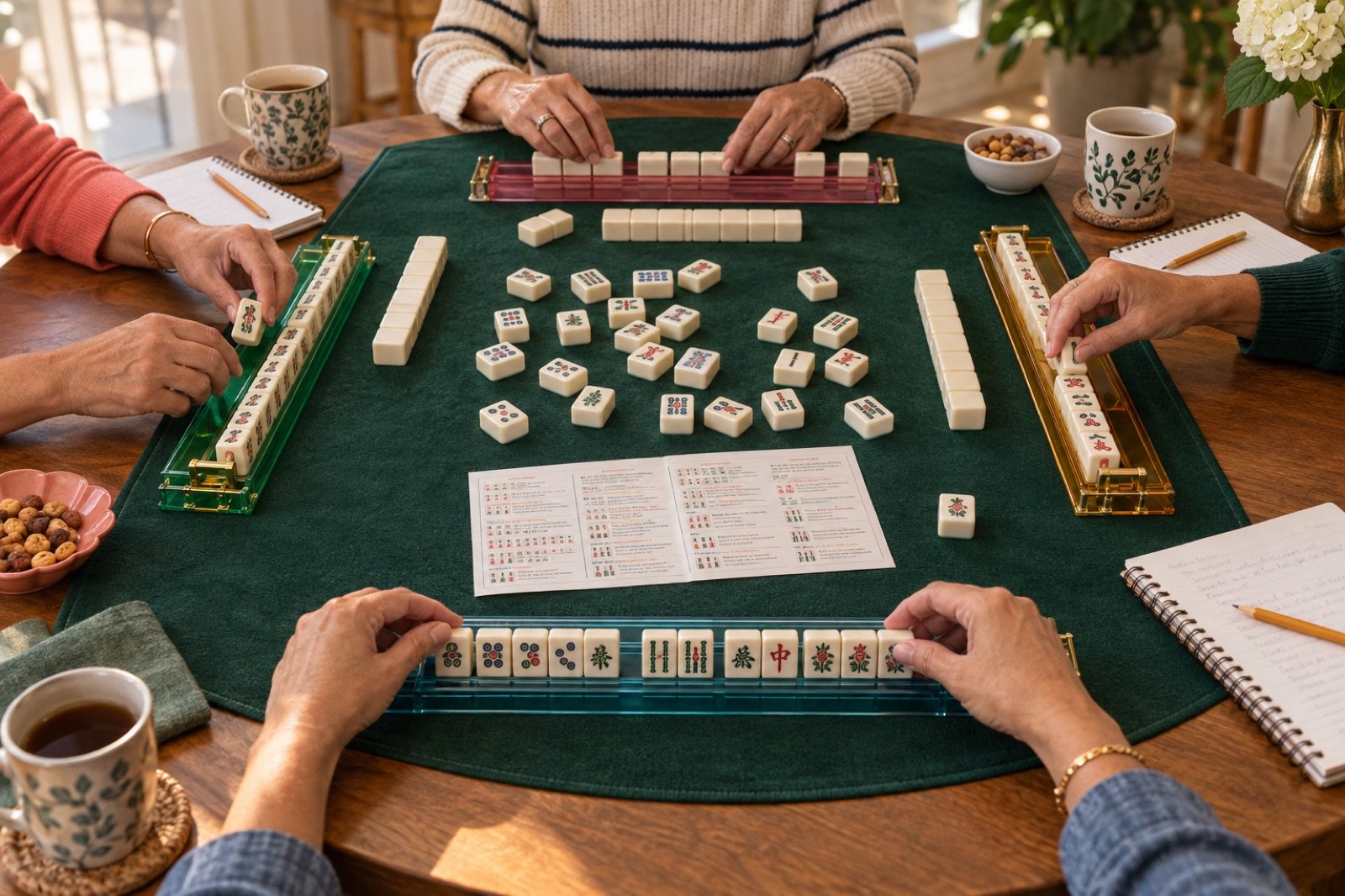
Rack organization should help you see possibilities without arranging tiles into an obvious public blueprint. A neutral, repeatable system makes card scanning faster and reduces the urge to reshuffle the entire hand after every draw.
Group broad tile families first, keep pairs visible to yourself, separate clear passes from flexible tiles, and avoid spacing that reveals exact card groupings. Reset to the same neutral order after each decision.
Choose a neutral base order
Many players begin with suits together and honors or flowers at one end. The exact order matters less than consistency. A neutral base lets you notice a new pair or run immediately after drawing.
Do not copy a card line perfectly across the rack early in the game. Exact group spacing can announce both the section and missing positions.
Create three mental zones
Think of the rack as strong tiles, flexible tiles, and likely discards, but avoid dramatic physical gaps. Strong tiles include natural pairs and difficult requirements. Flexible tiles support several candidate hands. Likely discards have little overlap.
The zones are temporary. A single draw can move a tile from the edge of your plan to its center.
Keep pairs easy to find
Pairs deserve attention because jokers generally do not replace them under common rules. Place matching tiles adjacent without advertising their role through large spacing.
When several candidate hands share a pair, treat it as an anchor while comparing the rest of the line.
- Consistent suit order
- Pairs adjacent
- Flexible tiles easy to scan
- Likely discards identified
- No revealing group-sized gaps
Limit constant rearranging
Repeatedly moving every tile consumes time and can reveal what changed after a draw. Insert the new tile, compare candidates, and make only the smallest useful adjustment.
If the rack becomes confusing, perform one deliberate reset to your neutral order while the table is between actions.
Use the card alongside the rack
Place the current card where you can shift your eyes without leaning over the tiles. Read one candidate line at a time, then look back at the rack and count exact matches. Do not try to hold every line in memory.
Speed comes from a repeatable comparison process, not from hiding that you use the card.
Frequently asked questions
Should you arrange Mahjong tiles in card order?
It may help you think, but exact group spacing can reveal your plan. A neutral consistent order protects information.
Where should flowers and jokers go on the rack?
Use a consistent location that helps you scan, while avoiding a layout that exposes your intended card line.
Why do experienced players move tiles less?
They often use a stable base order and compare candidates mentally, which saves time and reveals less after each draw.
Reviewed for clarity and accuracy in September 2026.