
Journal
How to Teach a First American Mahjong Lesson

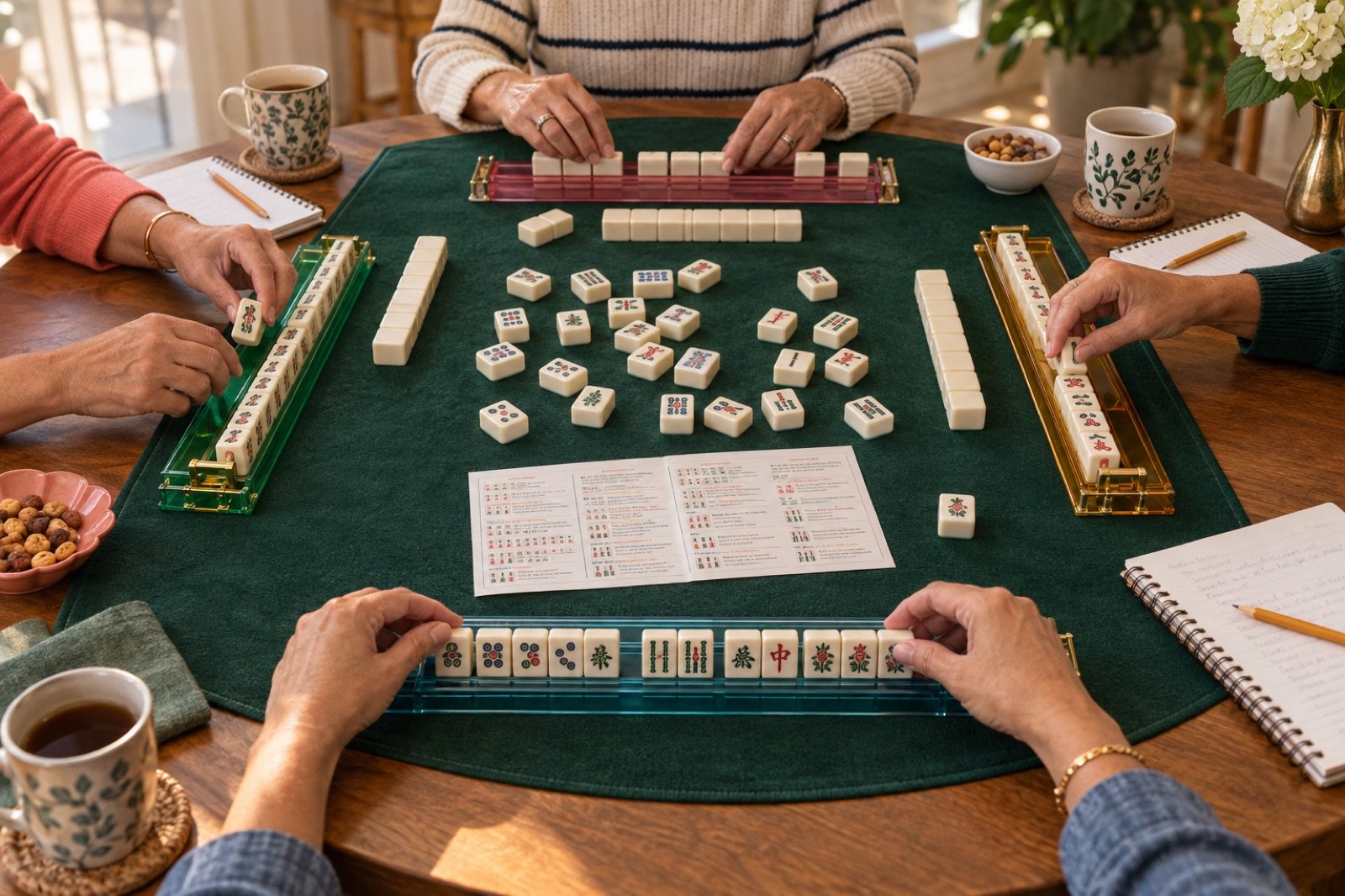
A first lesson works best when learners experience one complete game rhythm without being asked to memorize every exception. Teach recognition, card logic, and turn order in layers, then let a guided hand connect them.
Begin with tile families and the annual card, demonstrate draw-assess-discard, walk through one Charleston, and play an open guided hand. Save scoring detail and rare rule questions for later unless they arise naturally.
Prepare a low-pressure table
Tell learners how long the lesson will last and that consulting the card is normal. Use readable tiles, compatible racks, good light, and a quiet mat. Give each player the same current card or authorized rules reference.
Remove unnecessary decor and keep drinks on a side surface so attention stays on the game.
Teach tile families first
Introduce dots, bams, cracks, winds, dragons, flowers, and jokers. Ask learners to sort a small mixed group and name each family. Do not begin by reciting every count from memory.
Point out any suit indices or design variations specific to the set before the symbols appear inside a hand.
Explain how the card communicates
Show colors as suit placeholders, grouping sizes, year numbers, dragons, flowers, and exposed or concealed status using general examples. Do not reproduce or distribute the copyrighted card interior.
Let learners locate one simple line and build a sample hand with loose tiles.
- Recognize tile families
- Read one card line
- Practice draw-assess-discard
- Demonstrate the Charleston
- Play one guided hand
- End with three remembered rules
Demonstrate before requiring
Perform one slow turn and one three-tile Charleston pass while naming the actions. Then let players repeat. During the guided hand, keep racks partly open if everyone agrees so rules can be connected to visible decisions.
Correct one concept at a time. Avoid rebuilding a learner's rack for them.
Finish with a useful review
Ask each learner to name the turn rhythm, one Joker limitation, and where to check whether a hand is exposed or concealed. Give them a short next-step path: review the glossary, practice card reading, and join another relaxed table soon.
A learner who understands where to find an answer is better prepared than one who heard thirty exceptions once.
Frequently asked questions
How long should a first American Mahjong lesson be?
Plan enough time for tile recognition, card basics, a Charleston demonstration and one guided hand, with a break if the session is long.
Should beginners play with open racks?
A guided teaching hand can use open information when everyone agrees, because visible decisions make rules easier to explain.
What should be taught first in American Mahjong?
Start with tile families, how the card communicates, and the draw-assess-discard rhythm before detailed strategy.
Sources and scope
Rules can vary by organization and table. Use the current card and official materials selected by your group.
Reviewed for clarity and accuracy in September 2026.